
What is a downlight?
LED downlights are one of the most common lighting fixtures in modern homes. They are very popular because they provide warm general lighting that is unobtrusive compared to traditional light fixtures. However, there are many factors to consider when shopping for the perfect product. Should You Choose LED Bulbs or Halogen Bulbs? What is the ideal wattage and spacing?
Below we've put together a simple guide to help answer your questions. Whether you're considering installing LED downlights or already have them, here's how to pick the right one for you.
LED Downlights vs Halogen - Wattage
For wattage, you want your downlight to be both energy efficient and deliver high beam. Therefore, we encourage you to use LED downlights. An average 10W LED downlight can produce twice the beam of light as a halogen lamp using up to 55W. In terms of energy savings, the best options are as low as 4.5 watts to 14 watts of LEDs.
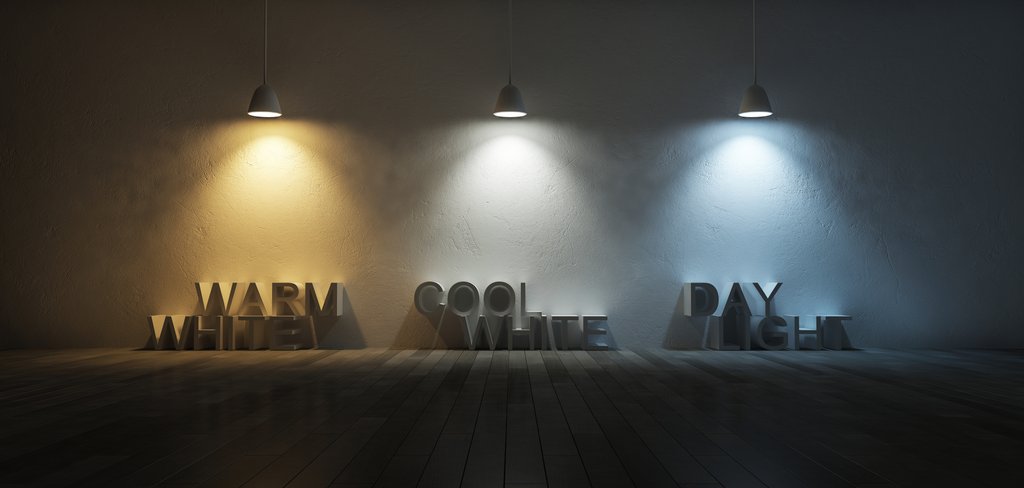
color temperature
As a general guide when selecting LED downlights for rooms that tend to get hot, such as indoors. In the kitchen or laundry room, cool white is ideal. However, if you want warmth and intimacy in your space, for example a living room or bedroom, warm downlights are better than cool white downlights.
We recommend Natural White 4000K as a good all-rounder. It's cool, clean, and feels warm but doesn't overwhelm your eyes—like you have natural skylights streaming in from the ceiling. Below is a photo so you can see the difference in color temperature.
You can also read our another article, What are the advantages of LED downlights?
What are lumens?
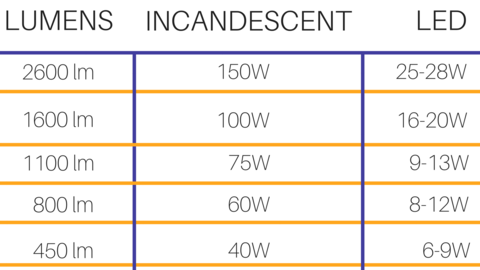
In the past, you could tell how bright a lamp was by looking at the wattage on the bulb packaging. This is still the case with halogen and fluorescent lights, but LED lights are usually always low wattage due to energy saving technology. Therefore, we now use lumens (lm) to understand the brightness of LED lights. Lumens measure the total amount of visible LED light emitted by a bulb. The higher the lumen, the brighter the LED light.
Energy Efficiency - Lumens per Watt
When choosing a downlight, LED options are a balance between efficiency (watts) and brightness (lumens). For example, if you normally use 60 watt incandescent bulbs, now you may want to opt for an 8 to 12 watt LED downlight rated at 800 lumens to get the same amount of light.
However, if you're confused about lumens, don't worry! The chart below gives you a guideline for lumens per watt compared to
Downlight Beam Angle
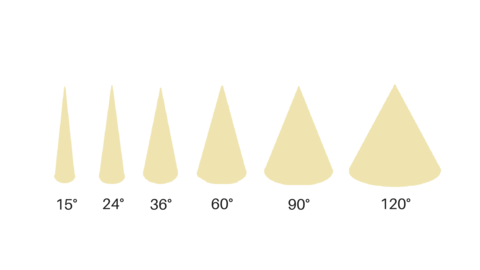
The beam angle is the amount of light traveling from the lamp and can be measured in degrees. Most have a 45° beam angle because they are recessed. In comparison, a normal light bulb has a beam angle of 360°.
Because they are recessed, we recommend opting for downlights with wider beams (60°), eg if you want soft diffuse lighting. in the living room. However, if you are looking for a downlight for the kitchen, the narrower beam (25°) angle is preferable as it will give you a focused light, ideal for those who need to illuminate surfaces and focus on smaller details in the room Condition.
No matter the size of the room, a pool of light will always look better than harsh light and it will create more ambiance in your space.
In general, if you're not sure which beam angle to choose, anything between 60 and 120 degrees will do in most cases. Below is a photo to help you observe the angle of the beam.
Downlight Spacing for Beam Angles
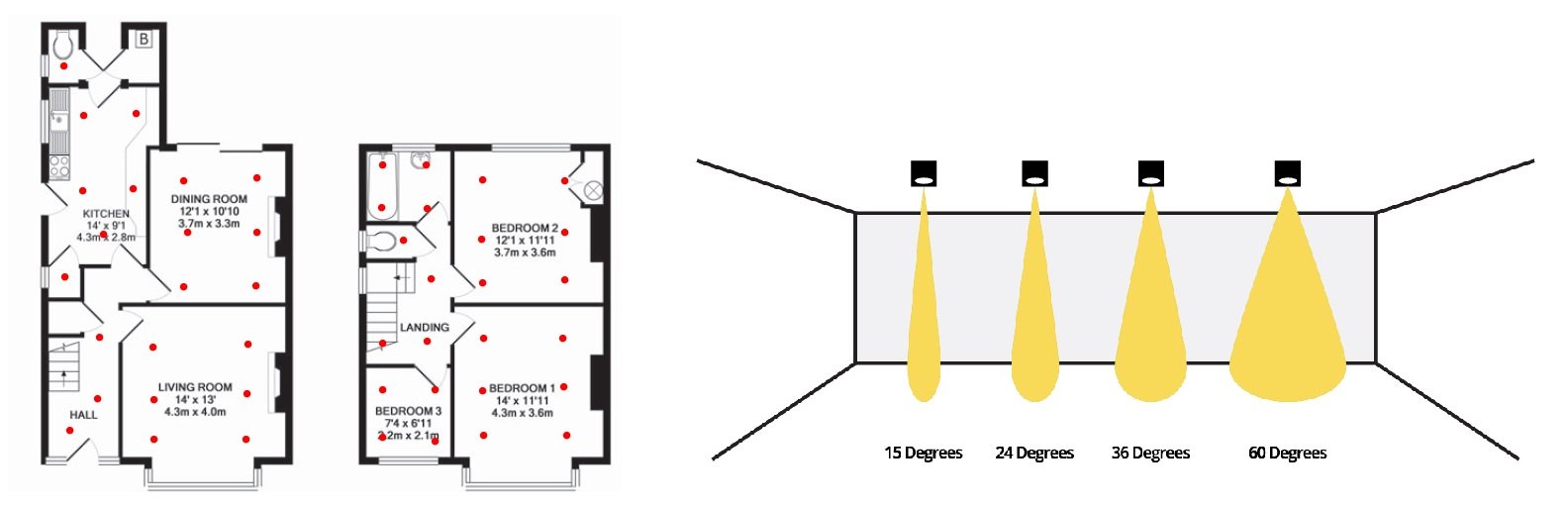
Before installing, make sure you think of beam angle when considering how far apart to space them.
If you are using a wider beam you can generally space the downlights 1.2 to 1.5 metres. If you are using a concentrated beam light, try spacing them 1 metre away from each other.
When you install the recessed downlights in your room, calculate the total needed then space them exactly the same apart throughout the room.
We are a professional manufacturer of LED downlight
Color Rendering Index (CRI)
CRI refers to the ability of a light source to faithfully represent the color of an object compared to natural sunlight. The index is measured on a scale of 0-100, with a perfect 100 indicating that the color in the light is the same as in natural sunlight. Typically, a CRI of 80 - 90 will be within the range for accurate color rendering.
If you want your lights to have beautiful, vibrant hues across the color spectrum, we recommend a high CRI (90+) and a color temperature in the middle of the range (4000K).
Downlight life
Of course, it depends on the type of your investment. Halogen downlights last an average of 2,000 hours. Many people find that they replace most of their halogen bulbs within 12-18 months.
The service life of the LED downlight is 50,000 hours, if the light is turned on for 5 hours a day, it will be about 27 years. As you can see, these methods are more cost-effective in the long run.
We in the store still get asked all the time how do I replace an LED downlight? It depends if it's built in or not. Now most of them are built-in fixed lights and drivers, separated by plugs like the picture below, when the lights are built-in, you can only replace the whole light fixture, including the downlight driver. The driver is designed to run with this light only, you can't just buy another driver to run the light, you have to replace the entire downlight kit.
Replacing Downlights
If your downlight has a sphere like the one pictured below, then you can replace the LED downlight sphere by rotating the center ring and pulling out the center ring, the sphere can now be removed and replaced from the back.
Insulation Contact (IC) Rating
IC ratings are used to determine if a recessed downlight is suitable for contact with your building insulation.
Lamps with an IC rating can come into direct contact with building insulation and ceiling timbers without causing a fire.
When choosing an IC rated lamp, make sure it has a warranty of at least 3 years. Never buy halogen downlights without an IC rating and place them near insulation or wood.
Final Tips for Choosing Downlights
It's a long list, but selecting and installing downlights is a big decision. Here are some final tips for us to consider.
1. Light-colored walls look brighter and let in more light than darker, light-absorbing surfaces. Keep this in mind when considering light spacing, brightness, and beam angle.
2. Use dimmers for your downlights to further save electricity. However, please note that not all dimmers and dimmable LEDs are compatible. Look for a reputable LED supplier that can provide a compatibility chart listing dimmer brands and types.
3. If you do choose to install dimmers, use push-button dimmers. They sit flush with the wall for a sleek look and also double as on/off switches.
4. Only buy from trusted wholesale brands with genuine warranties and quality. There are plenty of cheap imports available online, however, downlights that are cheap online don't necessarily meet Australian standards and if they go wrong it could cost you dearly later.
5. Look for a standard plug base so you can plug in and flick without needing an electrician.
6. When buying LED downlights you should consider buying the 90mm size as these are the most commonly sold which means you will buy them cheaper as they are produced in greater quantities and when you change fixtures , they will be easier to change sizes.
7. When you are looking for where to buy, you should only be looking to buy from quality wholesalers. The market is flooded with different grades, so only buy from big companies that offer genuine warranties and meet Australian standards.
8. When changing halogen lamps to LEDs, please pay attention to buy warm white to match the same color temperature.
9. Installation is required after purchasing the lights, make sure you use a reputable electrician, installation can cost $50 to $70 per light.
10. When removing the LED downlight, pull it down from the roof slowly so as not to break the plasterboard and be careful not to hit your fingers with the springs.
Many people ask what is the difference between spotlights and downlights. A spotlight will accentuate something like a work of art, the beam angle will be very straight and narrow, a downlight will have a wider beam angle, the wider the angle the less it is needed.